Carbon molecular sieves (CMS) separate oxygen from nitrogen through kinetic separation. Their precisely controlled micropores allow oxygen molecules to diffuse into the pores faster than nitrogen molecules. As a result, CMS preferentially adsorbs oxygen while allowing nitrogen to pass through as the product gas.
This selective adsorption is the basis of pressure swing adsorption (PSA) nitrogen generation. By changing the pressure around the CMS bed, the system can release the adsorbed oxygen and regenerate the sieve for repeated nitrogen production.
Key Takeaways
- Carbon molecular sieves are porous carbon-based adsorbents made from carbon-rich precursors through carbonization and activation.
- CMS separates oxygen and nitrogen through kinetic selectivity, using their different diffusion rates.
- Oxygen diffuses into the micropores faster than nitrogen and is preferentially adsorbed.
- PSA alternates between high-pressure adsorption and low-pressure desorption to regenerate the CMS bed.
- Multiple CMS beds can alternate between adsorption and regeneration to provide continuous nitrogen production.
What Are Carbon Molecular Sieves Made Of?
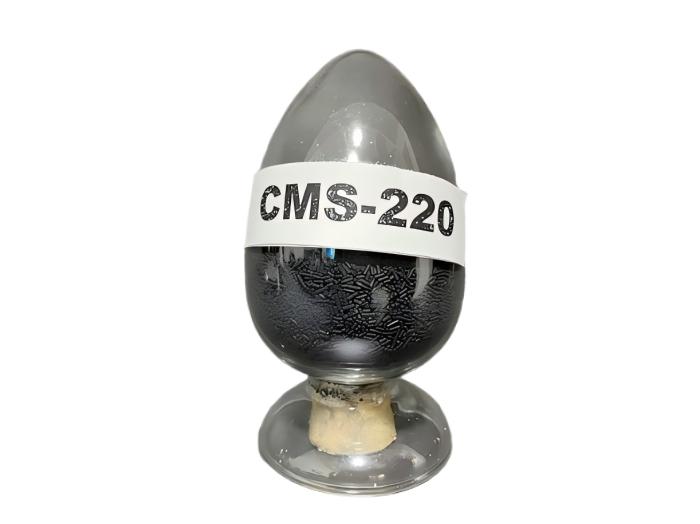
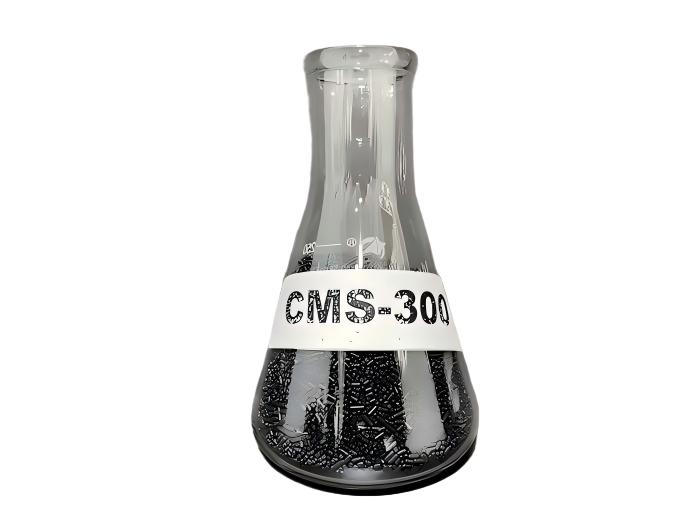
Carbon molecular sieves (CMS) are porous carbon-based adsorbents with precisely controlled micropores. They are commonly produced from carbon-rich precursors such as coal, petroleum pitch, polymer resins, and biomass-derived materials.
These materials undergo controlled carbonization and activation to create a microporous carbon structure. The resulting pore size and distribution determine how effectively the CMS can separate different gas molecules.
How Carbon Molecular Sieves Separate Oxygen and Nitrogen
CMS separates oxygen and nitrogen through kinetic selectivity. The process takes advantage of the different rates at which the two gases diffuse into the CMS micropores.
Faster Oxygen Diffusion
Compressed air contains mainly nitrogen and oxygen. As the gas passes through the CMS bed, both molecules come into contact with the microporous carbon structure, but they do not enter the pores at the same rate.
Oxygen molecules diffuse into the micropores more quickly than nitrogen molecules. The CMS therefore preferentially adsorbs oxygen, while nitrogen remains mainly in the gas phase and continues through the bed.
As more oxygen is retained inside the CMS, the gas leaving the bed becomes enriched in nitrogen. This difference in diffusion and adsorption behavior is what allows CMS to separate nitrogen from compressed air without mechanically filtering the two gases.
Micropore Size Controls Selectivity
Oxygen and nitrogen have very similar kinetic diameters, so CMS requires carefully controlled pore openings to create an effective difference in diffusion rates.
If the pores are too large, nitrogen can enter them more easily, reducing the difference between oxygen and nitrogen diffusion. If the pore-size distribution is too broad, the separation can also become less selective because different pores may allow both gases to diffuse at similar rates.
A precisely controlled micropore structure helps oxygen diffuse and adsorb faster than nitrogen. This improves the kinetic selectivity of the CMS and allows more nitrogen to pass through as the product gas.
How PSA Uses Carbon Molecular Sieves
PSA uses changes in pressure to repeatedly load and regenerate the CMS bed.
Adsorption Under High Pressure
Compressed air enters a vessel filled with CMS under elevated pressure. Oxygen rapidly diffuses into the CMS micropores and is preferentially adsorbed, while nitrogen passes through the bed more slowly.
The gas leaving the vessel is therefore enriched in nitrogen and collected as the product gas. As adsorption continues, the CMS gradually becomes loaded with oxygen and approaches its adsorption capacity.
Desorption Under Low Pressure
Once the CMS bed becomes sufficiently loaded with oxygen, the system reduces the pressure inside the vessel. The lower pressure weakens the adsorption of oxygen and allows the trapped oxygen to leave the micropores.
The released oxygen exits with the waste gas, leaving the CMS bed with available adsorption sites again. The regenerated bed can then return to the high-pressure adsorption stage.
Alternating Beds Enable Continuous Nitrogen Production
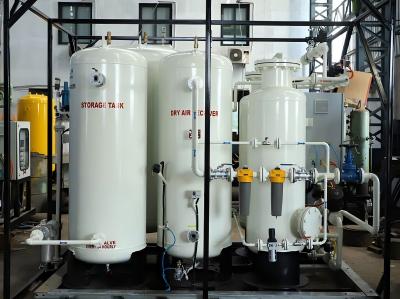
A typical PSA nitrogen generator uses two or more CMS beds to maintain continuous production. While one bed operates under high pressure and produces nitrogen, another bed is depressurized to release the adsorbed oxygen and regenerate the CMS.
After regeneration, the beds switch roles. This alternating cycle allows one bed to keep producing nitrogen while another is being prepared for the next adsorption stage, so the nitrogen supply does not need to stop between cycles.
FAQ
What is the difference between carbon molecular sieve and activated carbon?
Carbon molecular sieves have a more precisely controlled micropore structure designed for selective gas separation, while activated carbon generally has a broader range of pore sizes and is mainly used for adsorption and purification.
Why does CMS adsorb oxygen instead of nitrogen?
CMS does not simply separate gases because oxygen is much smaller than nitrogen. Oxygen and nitrogen have similar kinetic diameters, so the controlled micropores exploit their different diffusion rates. Oxygen enters the pores faster and is preferentially adsorbed.
Does carbon molecular sieve remove oxygen permanently?
No. Oxygen is adsorbed during the high-pressure stage but can be released when the pressure is reduced. This reversible adsorption allows the CMS bed to be regenerated and reused.
What happens when a CMS bed becomes saturated?
As the CMS bed becomes loaded with oxygen, its ability to continue adsorbing oxygen decreases. The PSA system then reduces the pressure to release the adsorbed oxygen and regenerate the bed.
Why does PSA use more than one CMS bed?
Multiple beds allow adsorption and regeneration to occur at the same time. This avoids stopping the nitrogen supply while one CMS bed is being regenerated.