
Carbon molecular sieve (CMS) is a special material that pulls certain gases out of a mix by grabbing them onto its surface. This tech is key for making nitrogen, cleaning gases, and many factory uses. The world market for molecular sieves keeps growing as more industries need better gas separation. This piece looks at CMS trends, market shifts, and how suppliers plan their moves in the larger global molecular sieves market.
Key Takeaways
- The carbon molecular sieve market is growing steadily, and it is expected to reach $6.3 billion by 2034.
- Key reasons are the growing need for nitrogen production and tougher environmental rules.
- Suppliers that spend on new technology and green practices will lead the market.
Carbon Molecular Sieve Market Size & Growth
Valuation & Forecast
Current market valuation and projected growth rates
The carbon molecular sieve market keeps growing steadily. In 2024, the market was USD 3,674.23 million. By 2025, it rose to USD 3,874.48 million. Experts expect the market to reach USD 6,326.85 million by 2034. This is a CAGR of 5.6% from 2025 to 2034. Other estimates vary; for instance, one source projects the market to reach USD 5.494 billion by 2035. These different numbers come from different ways of counting and areas covered.
Comparison of different market estimates
| Source Perspective | Base Year | Projected Value | Target Year |
|---|---|---|---|
| Conservative estimate | 2024 | USD 6,326.85 million | 2034 |
| Alternative estimate | 2024 | USD 5.494 billion | 2035 |
The differences come from how each expert defines the market. Some count only pure CMS products. Others include related separation technologies. Buyers should look at these numbers closely when planning investments.
Growth Drivers & Metrics
Key factors driving market expansion
Several things push the global molecular sieves market forward. The drug industry needs more CMS to clean active ingredients and dry solvents. More older people means more healthcare spending, which boosts drug making. Tighter environmental rules also push adoption. Industries must remove pollutants like VOCs and SO2, and CMS offers high adsorption efficiency. New technology creates sieves with better selectivity and heat stability. These new uses grow in petrochemical catalysis and gas separation.
- Growing drug and health sectors raise the need for moisture control.
- Strict EPA rules force industries to use CMS for pollution control.
- Ongoing research creates sieves that can absorb more and stay stable longer.
Metrics used to measure market growth
Experts measure the molecular sieves market size using several numbers. Revenue figures give the base. Regional trends give another view. Asia-Pacific leads in electronics and manufacturing uses. North America and Europe focus on following environmental rules and saving energy. Making industrial nitrogen is the biggest use. Electronics making and food packaging drive this demand. The oil and gas sector adds a lot through methane separation and hydrocarbon recovery.
| Metric | Value |
|---|---|
| Market Size (2024) | USD 3,674.23 million |
| Market Size (2025) | USD 3,874.48 million |
| Projected Market Size (2034) | USD 6,326.85 million |
| CAGR (2025-2034) | 5.6% |
These numbers show the carbon molecular sieve market growing steadily. Suppliers add new production capacity. Demand from many industries keeps the growth path strong. Understanding these trends helps people make smart choices about the global molecular sieves market.
Global Molecular Sieves Market: Drivers and Challenges
Key Drivers
Industrial demand for nitrogen generation
Industrial nitrogen generation is the main reason people need carbon molecular sieve. Factories use over 180 million Nm³/day of nitrogen to pack food, make electronics, and process metal. On-site pressure swing adsorption (PSA) systems that use CMS cut shipping costs by about 36% for roughly 58% of users. These systems give nitrogen that is over 99.9% pure, with oxygen below 0.1%. This helps control oxidation in nearly 47% of heat treatment jobs. Nitrogen PSA systems make up about 72% of all CMS use because they can pick out nitrogen very well and last over 100,000 cycles. This strong demand pushes the market toward more on-site nitrogen making, which is about 44% of all CMS use.
The U.S. market for carbon molecular sieves that make nitrogen is split into two parts: ‘Industrial Nitrogen Generation’ and ‘Lab Nitrogen Generation’. Industrial generation is the main use.
Technological advancements in CMS production
New ways to make CMS are helping the market grow. Makers now build hierarchical pore structures that pick out molecules well and let them move faster. They use advanced tools and computer models to design these structures. They also change the surface by adding different atoms or forming composites to improve how well it works and how strong it is. Some new membranes mix oxide and carbon using vapor with metal-organic materials. This lets them heat at lower temperatures and stay stable. These new ideas let CMS work in cleaning hydrogen and processing natural gas, which helps make clean fuels.
Challenges & Restraints
High production costs
Making CMS costs a lot of money. Big factories cost $50 to $150 million, and it takes 3 to 5 years to earn that money back. Raw materials make up 35 to 45% of the production cost. Energy is 25 to 30% of the operating costs. Most factories use people to watch the process, so they cannot catch problems right away when heating and activating the material. These high costs make it hard for new companies to start and slow down market growth.
| Cost Factor | Current Impact | Potential Improvement at Scale |
|---|---|---|
| Capital Investment | $50–150 million for large-scale facilities | Payback period reduced to 3–5 years |
| Raw Materials | 35–45% of total production expenses | 20–30% reduction via supplier contracts |
| Energy Consumption | 25–30% of operational costs | Up to 40% reduction via heat recovery |
| Per-Unit Production Costs | High due to energy and limited automation | 40–60% reduction through optimization |
Competition from alternative technologies
Membrane separation and cryogenic distillation are other ways to separate gases. They sometimes cost less energy or are easier to run. But CMS is still better for making nitrogen and cleaning hydrogen where you need very pure gas. Rules also affect the competition. The EU’s REACH rules and US EPA standards push factories to use cleaner methods. This helps energy-saving adsorption technologies like CMS. These rules give CMS a chance even though it costs more, because factories want sustainable ways to separate gases for clean fuels and natural gas.
Carbon Molecular Sieve Technological Advances

Innovations in Production
New manufacturing processes
Recent innovations focus on creating hierarchical pore structures that combine molecular-level selectivity with enhanced mass transfer, supported by advanced characterization and computational modeling. Surface modification techniques, including heteroatom doping and composite formation, improve selectivity, adsorption capacity, and mechanical strength. Hybrid inorganic oxide-carbon membranes enable lower temperature pyrolysis and improved stability.
Improvements in material properties
Adjusting pore size and structure through templating and controlled heating improves gas separation. Carbon molecular sieve now allows small gases to pass through quickly while blocking larger ones. These improvements expand the material’s application range.
Application Developments
Expanding uses in various industries
Beyond nitrogen generation, CMS finds new jobs in various industrial gas separation applications. The global molecular sieves market gains from these new uses.
Integration with other separation technologies
CMS works with other systems for energy-saving and cost-effective separation. Its adsorption traits complement cryogenic distillation for certain gas mixes. The global molecular sieves market keeps growing as CMS technology improves. Clean fuel production depends on CMS for efficient gas separation. Sustainable fuel technologies create fresh demand. The CMS market shows steady growth across many sectors.
Regional Carbon Molecular Sieve Markets
North America & Europe
Market trends and growth factors
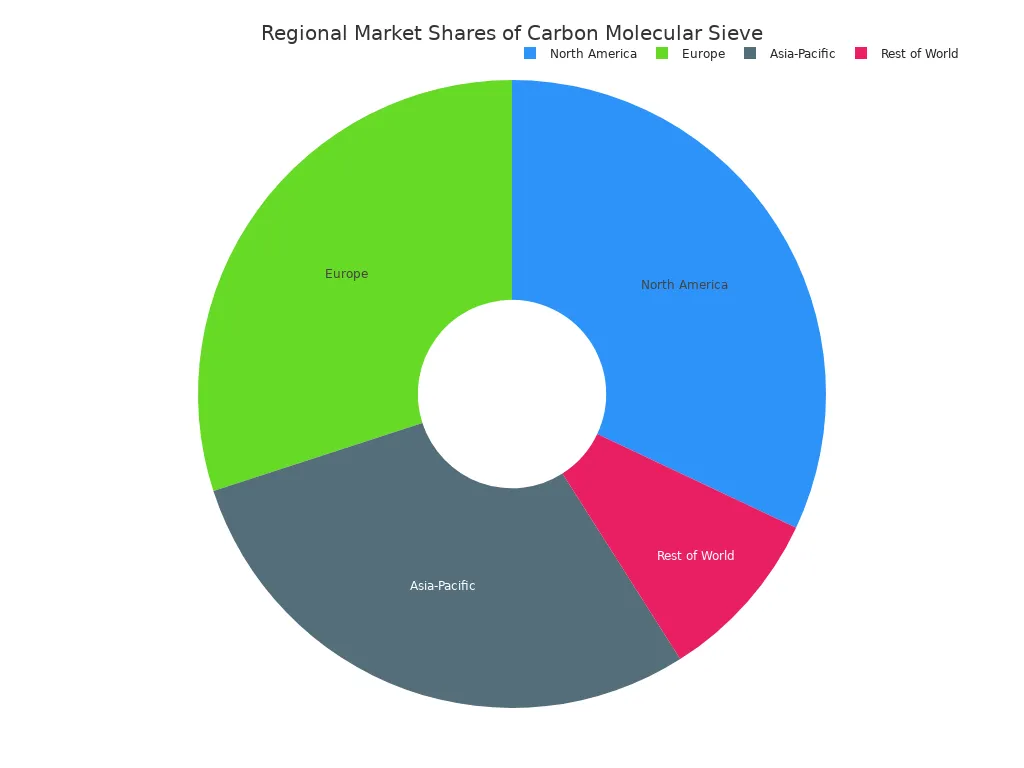
North America is a major market for carbon molecular sieve, supported by strong drug making and electronics production. Industrial gas processing systems also keep demand steady. Europe is also a significant market, with strong factories and need for clean processing systems. Both regions show mature markets with steady growth.
The global molecular sieves market gains from these strong regions. Companies in North America and Europe focus on following rules and saving energy. Environmental laws push factories toward cleaner separation methods. This keeps demand steady for carbon molecular sieve products.
Key players and regulatory environment
Major suppliers work across both regions. These companies put money into research to make better products. Rules like REACH in Europe and EPA standards in the United States shape how products are made. Makers must meet strict certification needs. This makes it harder to enter the market but ensures products work well.
Asia-Pacific & Rest of World
Emerging markets and industrialization
Asia-Pacific is a growing market, driven by fast industrial growth and more electronics production. Drug making also grows across the region. Rest of World is an emerging market, with food processing, petrochemical plants, and healthcare growing in Latin America, the Middle East, and Africa.
| Region | Market Share | Key Supporting Context |
|---|---|---|
| North America | Major | Strong pharmaceutical manufacturing, electronics production, and industrial gas processing infrastructure. |
| Europe | Major | Strong industrial manufacturing capabilities and demand for contamination-free processing systems. |
| Asia-Pacific | Major | Rapid industrialization, expanding electronics manufacturing, and increasing pharmaceutical production. |
| Rest of World | Emerging | Growth in food processing, petrochemical manufacturing, and healthcare industries across Latin America, Middle East, and Africa. |
Opportunities and challenges
New regions offer big chances. More need for oxygen concentrators and hydrogen projects creates fresh uses. Building projects in Asia-Pacific help the market grow. Local players enter Africa and Latin America with custom solutions. More research money in new markets boosts new ideas.
Challenges stay big. High making and material costs slow adoption. Strict rules and certification needs slow market entry. Competition from membranes and cryogenic distillation pressures prices. Supply chain problems from material shortages and shipping delays hit all regions. These factors shape the molecular sieves market size and growth path.
Carbon Molecular Sieve Supplier Landscape

Major Suppliers
Overview of leading manufacturers
The carbon molecular sieve market has several key manufacturers around the world. These companies supply CMS products for various industrial gas separation needs. Some manufacturers focus on energy-saving products and hold certifications for quality and environmental management.
Market share and product portfolios
| Manufacturer | Headquarters | Core Products (CMS-related) | Certification |
|---|---|---|---|
| Manufacturer A | Various | CMS products for nitrogen generation | Quality management |
| Manufacturer B | Various | CMS products for industrial gas separation | Environmental management |
| Manufacturer C | Various | CMS products for various applications | Safety management |
Manufacturers stand out because of steady product quality and ongoing research spending. They hold certifications for quality, environmental, and safety management. These credentials show the promise to reliable supply and good operations.
Competitive Strategies
Mergers and acquisitions
The global molecular sieves market sees active deal-making. Companies acquire others to expand their product lines and reach. These moves change the competitive field and widen product lines.
Product differentiation and innovation
Makers stand out through new ideas and special products. Advanced production lines and facilities support steady quality. Manufacturers plan to grow market presence through research spending, strict quality checks, and better customer service.
The carbon molecular sieve market rewards makers who invest in separation technology improvements. CMS products serve various industrial applications. This focus on quality and new ideas puts suppliers in a strong position. Buyers looking for wholesale or custom CMS solutions find reliable partners among these leading makers.
Future Outlook for the Carbon Molecular Sieve Market
Emerging Trends
Sustainability and green technologies
Going green now shapes the future of the carbon molecular sieve market. Industries want separation methods that use less energy and cut carbon footprints. Hybrid systems built on carbon molecular sieves work better and may use less energy overall than older methods.
Companies now care more about the environment. They want separation methods that use less energy and leave a smaller carbon footprint.
These sieves help cut carbon emissions, which is a top goal in fighting climate change. By using these materials, industries lower their carbon footprint and meet global targets. They work well across many uses, making them key tools for sustainability. Carbon molecular sieve membranes made from polyimide greatly improve energy-heavy separations. They offer better efficiency and sustainability.
Digitalization and smart manufacturing
Digital tools are changing how companies make carbon molecular sieves. Integration with digital monitoring systems allows for better process control and quality assurance. Automation and data analysis improve production precision and efficiency.
Using digital tools for smarter production is a big chance for the carbon molecular sieves market. These tools boost efficiency and allow custom products.
Investment Opportunities
Potential growth areas
Investors can look at different CMS types. Some types serve electronics and drugs with rising purity needs, while others appeal to cost-focused sectors through energy savings. The second type offers a clear opening for green investments in energy-saving tech.
| Investment Area | Projected CAGR |
|---|---|
| Adsorption cycle 120s segment | 5.5% |
| Gas separation application | Highest |
| Asia-Pacific region | 5.7% |
These numbers show the fastest-growing areas. They tell investors where to put money for the best returns over the next ten years. This growth comes from efficiency and cost savings in industrial gas production. This makes it a strong investment area in the market.
Strategic recommendations for stakeholders
Stakeholders should look at sharing resources to cut production costs. R&D spending improves CMS materials and their lifespan for better returns. Marketing the green benefits raises awareness and boosts demand. These company moves show where private money flows and point to good investment targets. The global molecular sieves market keeps growing as clean fuel and hydrogen purification uses expand. More industries want purification tech for cleaner operations. These trends point to steady growth and fresh chances for investors.
The carbon molecular sieve market shows steady growth, with a market size of USD 3,674.23 million in 2024, projected to reach USD 6,326.85 million by 2034 at a CAGR of 5.6%. Asia-Pacific leads regional growth. The global molecular sieves market depends on CMS for efficient nitrogen generation and purification. Suppliers investing in innovation will capture expanding opportunities.
| Metric | Value |
|---|---|
| Market Size 2024 | USD 3,674.23 million |
| Projected Size 2034 | USD 6,326.85 million |
| CAGR (2025-2034) | 5.6% |
| Leading Region | Asia-Pacific |
FAQ
What is the role of carbon molecular sieve in gas separation?
CMS separates gases by pore size. It targets oxygen and nitrogen molecules in industrial gas separation.
What industries use CMS for hydrogen purification and other applications?
CMS helps with hydrogen purification, natural gas processing, and clean fuel production. It also works in food preservation and wastewater treatment. These jobs depend on gas separation.
What drives growth in the carbon molecular sieve market?
The global molecular sieves market grows steadily. The carbon molecular sieve market expands as nitrogen generation needs rise.