Three mature technologies are available to separate nitrogen and oxygen from air: cryogenic distillation, pressure swing adsorption (PSA) and membrane separation. Air contains approximately 78 % nitrogen and 21 % oxygen, serving as a low‑cost raw‑material source for steel‑making, medical oxygen supply, food modified‑atmosphere packaging and many other industries.
Each process delivers gas at different purity levels. Cryogenic distillation produces nitrogen from 99.9 % to 99.999 %. PSA systems achieve nitrogen purity between 95 % and 99.9 %. Membrane separation yields 90 %‑99 % nitrogen. Choosing the right technology balances gas purity, output capacity and operating cost. This article explains the workflow, pros and cons of each method.
Key Takeaways
- Cryogenic distillation delivers ultra‑high‑purity nitrogen up to 99.999 %, with higher energy consumption and upfront investment.
- PSA generators with carbon molecular sieves produce nitrogen up to 99.999 % purity and feature rapid startup.
- Membrane separation offers compact, low‑cost nitrogen supply for low‑flow applications, with a practical purity ceiling of around 99.5 %.
- Selection criteria: required purity, gas‑flow rate and project budget.
- Contact suppliers like YUANHAO for custom‑built PSA solutions.
Cryogenic Distillation to Separate N2 and O2
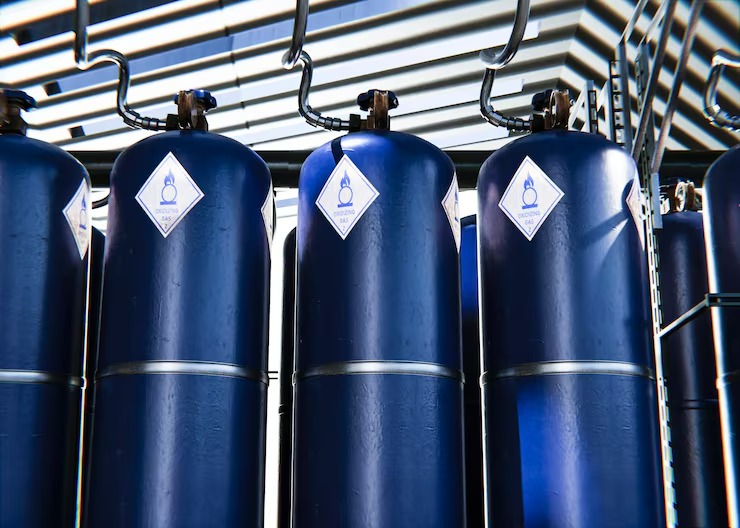
Cryogenic distillation is the preferred large‑scale air‑separation solution. Separation is achieved using the boiling‑point difference of nitrogen and oxygen.
| Gas | Boiling Point (°C) |
|---|---|
| Nitrogen | -195.8 |
| Oxygen | -183.0 |
The Process of Fractional Distillation
All cryogenic operations are carried out inside an insulated cold box.
- Air pretreatment: Ambient air is filtered, compressed, cooled to remove moisture, then treated by adsorbers to remove CO₂ and hydrocarbons to prevent freezing damage.
- Cooling: Purified air passes through multi‑stage heat exchangers, recovering cold energy from product gas streams and finally reaching liquefaction temperature.
- Distillation columns: Liquefied air enters the bottom of a high‑pressure tower. Feedstock is then transferred to a low‑pressure tower for improved separation efficiency.
- Gas separation: Nitrogen vaporises and rises to the upper tower section while oxygen remains liquid at the bottom. Argon is collected from a side column.
- Fractionation: Rising vapour and falling liquid create gas‑liquid equilibrium across trays. Typical towers contain 50‑100 trays, which determine final gas purity.
- Product recovery: Nitrogen, oxygen and argon are extracted at designated tray levels. Products can be stored in liquid form or vaporised for pipeline delivery.
Purity Levels and Industrial Applications
Cryogenic systems deliver nitrogen up to 99.999 % purity and oxygen up to 99.5 %, suitable for continuous large‑volume supply.
- Chemical industry: inert nitrogen blanketing to avoid oxidation and explosion risks
- Metallurgy: nitrogen shielding for heat‑treated metal parts
- Semiconductors: oxygen‑free environment for silicon‑wafer protection
- Healthcare: medical‑grade oxygen production
- Specialty gases: solar‑cell coating, wafer etching and laboratory research
- Food sector: nitrogen packaging to extend shelf‑life
Cryogenic plants are designed for long‑term non‑stop operation at large industrial‑gas facilities. High energy‑use and capital costs make this method uneconomical for small‑scale projects.
Pressure Swing Adsorption for Nitrogen Extraction from Air
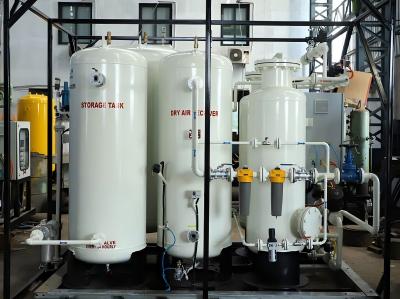
PSA provides reliable medium‑scale on‑site nitrogen production. Compressed air flows into adsorption towers filled with carbon molecular sieve (CMS). Oxygen molecules are selectively adsorbed while nitrogen passes through as finished gas. At least two towers work alternately: one adsorbs oxygen under high pressure, the other regenerates at low pressure.
How PSA Uses Carbon Molecular Sieves
CMS contains micro‑pores that trap oxygen far faster than nitrogen. This difference in adsorption speed enables air separation.
YUANHAO manufactures high‑performance CMS grades for different nitrogen‑purity targets. The table below shows output performance at 0.6 MPa and 0.8 MPa.
| Adsorption Pressure (MPa) | Nitrogen Purity (%) | Nitrogen Yield (L/h.kg) | N2 Recovery Rate (%) |
|---|---|---|---|
| 0.6 | 99.99 | 46 | ≥21 |
| 0.6 | 99.90 | 100 | ≥31 |
| 0.6 | 99.50 | 160 | ≥40 |
| 0.6 | 99.00 | 220 | ≥45 |
| 0.8 | 99.99 | 70 | ≥22 |
| 0.8 | 99.90 | 140 | ≥31 |
| 0.8 | 99.50 | 200 | ≥36 |
| 0.8 | 99.00 | 270 | ≥41 |
The chart below shows these patterns clearly. Higher pressure boosts output at every purity level, but purity still costs production volume.
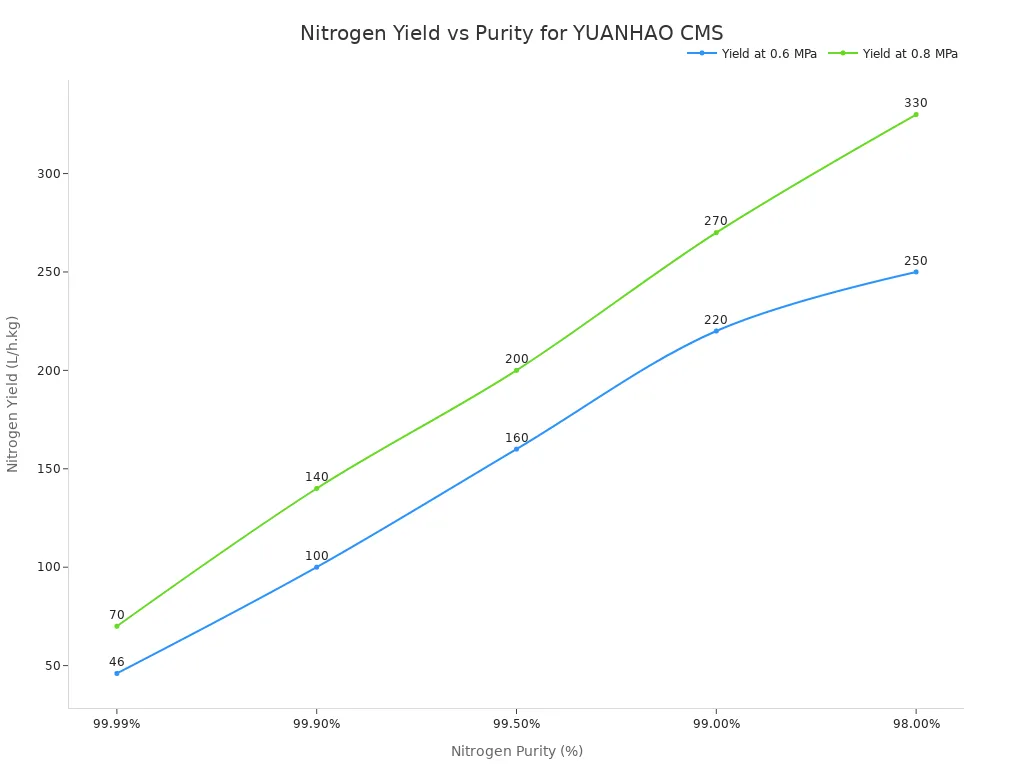
Higher pressure increases nitrogen yield; higher purity reduces hourly output. YUANHAO CMS selection guide: CMS‑240 (97‑98 % N₂), CMS‑300 (99.5 % N₂ for metal‑processing & pharmacy), CMS‑330 (>99.9 % N₂ for semiconductors). These sieves offer long cycle‑life, fast adsorption speed and high bulk density.
Advantages and Limitations of PSA
- Full nitrogen output reached within minutes, suitable for intermittent gas demand
- Small footprint and low civil‑construction requirements
- Moderate initial investment, far lower energy cost than cryogenic distillation
| Parameter | PSA Nitrogen Generator Range |
|---|---|
| Nitrogen Purity | 99% to 99.999% (multi-bed systems achieve the upper end) |
| Flow Rate | Hundreds to 100,000+ SCFH (tens of thousands of SCFH typical) |
Typical uses: metal‑recycling heat treatment, tank blanketing, wastewater‑treatment protection, on‑site oil‑field nitrogen supply.
Limitations
- Nitrogen purity ceiling around 99.999 %
- Large gas‑flow demand requires multiple PSA skids in parallel
- CMS media needs replacement every 5‑10 years
PSA offers excellent overall performance for medium‑scale nitrogen‑generation projects. YUANHAO supplies custom CMS formulations in bulk.
Membrane Separation to Separate Nitrogen from Air
Membrane separation is a compact on‑site nitrogen‑generation technology. Its core component consists of hollow polymer‑fibre bundles. Gas molecules pass through fibre walls at different permeation speeds.
The Principle of Selective Permeability
Oxygen permeates through polymer membranes much faster than nitrogen, due to its smaller molecular size and higher condensability. Compressed air enters the membrane module. Oxygen, water vapour and CO₂ permeate out as waste gas, while nitrogen flows through the fibre lumen as product gas. No moving parts or regeneration cycles are required.
Typical Uses and Performance Metrics
Single‑stage membrane units deliver 95 %‑99.5 % nitrogen. Higher purity reduces gas‑flow output. For nitrogen purity above 99.5 %, PSA or PSA+Deoxo systems are recommended. Membrane systems are lightweight, energy‑saving and nearly maintenance‑free, suited for low‑flow needs such as fuel‑tank inerting, pipeline purging and in‑transit food preservation.
Maintenance comparison:
| System | Maintenance Requirements | Lifespan |
|---|---|---|
| PSA | Periodic molecular sieve replacement every 5-10 years; valve and control system maintenance; higher frequency due to cyclic operation | Molecular sieve replacement interval 5-10 years |
| Membrane | Less frequent intervention; pre-filtration required; module renewal every 5-7 years | Membrane modules last 7-15 years, but renewal every 5-7 years |
Poor feed‑air quality shortens membrane service life. Membrane separation works well for projects that accept nitrogen purity ≤ 99.5 %.
Comparing the Three Separation Methods
When you pick a way to separate n2 and o2, you need to look at costs, energy use, and output. Each method works best for different jobs. The right choice depends on what you need.
Cost and Energy Consumption
Energy use is very different between the three methods. Cryogenic distillation uses the most power. It takes about 2.56 kWh for each kilogram of liquid nitrogen. That is about 2.02 kWh per cubic meter. The big cooling system causes this high number. PSA systems use much less energy. They use 0.31 to 0.63 kWh per kilogram of nitrogen gas. That is about 0.39 to 0.79 kWh per cubic meter. Membrane separation usually uses even less power at medium purity levels. But specific energy numbers are not available from standard sources.
| Technology | Energy Consumption (kWh/kg) | Energy Consumption (kWh/m³) |
|---|---|---|
| Cryogenic Distillation | 2.56 (liquid nitrogen) | ~2.02 |
| PSA | 0.31–0.63 (nitrogen gas) | ~0.39–0.79 |
| Membrane Separation | Not available | Not available |
Capital costs follow a similar pattern. Cryogenic plants need a huge upfront investment. They require cold boxes, compressors, and insulation. PSA systems need moderate money for vessels, valves, and carbon molecular sieves. Membrane systems have the lowest starting cost. That is because they are simple and compact.
Scalability and Purity Trade-offs
The three nitrogen methods also differ in how well they scale up. Cryogenic distillation works best for large tasks. It handles 10,000 to 30,000 Nm³/hr easily. One plant can make both oxygen and nitrogen at the same time. This lowers the energy cost per unit. PSA systems work well for small and medium tasks. They handle 0 to 10,000 Nm³/hr. You can add modular units in parallel for more flexibility. Membrane separation suits small-scale, on-site jobs. It works where space and budget are tight.
| Scale Range | PSA Technology | Cryogenic Distillation |
|---|---|---|
| Small (0–5,000 Nm³/hr) | Suitable; modular units add flexibility | Not typical due to high setup cost |
| Medium (5,000–10,000 Nm³/hr) | Feasible with parallel units; up to 99.9995% purity | Possible but less economical |
| Large (10,000–30,000 Nm³/hr) | Possible via parallel units, but capital cost rises | Traditional choice; produces both gases |
Purity trade-offs matter just as much. PSA gets high purity nitrogen up to 99% or higher. But energy use goes up sharply above 99%. Membrane systems deliver 90–98% purity in single-stage setups. They reach 99% only with multi-stage or hybrid designs. They use less energy at moderate purity. That is around 0.1–0.3 kW/Nm³ at 95%. But they struggle to reach ultra-high levels without extra equipment. The final choice depends on balancing purity, volume, and budget.
Cryogenic distillation, PSA, and membrane separation each offer distinct paths to separate N2 and O2. Cryogenic systems deliver the highest purity at 99.999% but demand massive energy and capital investment. PSA units using carbon molecular sieves provide flexible, medium-scale nitrogen production with purity up to 99.999% and quick startup times. Membrane systems offer compact, low-cost solutions for smaller operations, though purity caps near 99.5%.
The right choice depends on required purity, production volume, and budget. Large industrial facilities typically favor cryogenic distillation. Smaller operations benefit from PSA or membrane flexibility. Readers should evaluate their specific needs carefully. Consulting with suppliers like YUANHAO for CMS-based PSA systems helps ensure an informed decision that matches operational requirements.
FAQ
What method gives the purest nitrogen?
Cryogenic distillation gives the highest purity. It makes nitrogen up to 99.999% pure and oxygen up to 99.5% pure. This method works well for industries that need very pure gases, like electronics and chemical processing.
How do the three methods compare in energy use?
Cryogenic distillation uses the most energy. It takes about 2.56 kWh per kilogram of liquid nitrogen. PSA systems use much less, from 0.31 to 0.63 kWh per kilogram. Membrane separation usually uses the least power.
What is the best choice for medium-scale nitrogen production?
PSA systems work well for medium-scale needs. They use carbon molecular sieves to give nitrogen purity up to 99.999%. These systems start quickly and have moderate costs. They are ideal for metal recycling or food preservation.
How long does it take for each system to start making nitrogen?
PSA systems reach full output in minutes. Membrane systems also start quickly with little operator help. Cryogenic distillation needs hours or days to cool down before it starts making nitrogen.